
Technology Overview
Effective loss circulation control and wellbore stability management remain among the most persistent challenges in drilling operations. While significant research has been conducted in laboratory environments, field performance often diverges from laboratory outcomes.
This gap arises from the fundamental difference between controlled laboratory conditions and the dynamic, variable environment of drilling operations, where application decisions are frequently influenced by real-time constraints and operational pressures.
The Limitation of Conventional Approaches
Most specialty drilling additives are developed and validated under laboratory conditions. However, their field application is typically governed by:
- operational constraints
- variability in execution
- dependence on experience-based decision making
As a result, laboratory-optimized systems often fail to consistently deliver expected performance in the field.
This disconnect between design and application leads to suboptimal utilization of materials and inconsistent results.
Field-Led Development Philosophy
InvaSeal Solutions adopts a field-first approach to material development.
Rather than translating laboratory results into field applications, material behavior is defined based on field conditions, with laboratory development aligned to replicate and support these requirements.
This approach ensures that:
- materials are designed for real-world drilling environments
- application methodologies are practical and repeatable
- performance is consistent across varying operational conditions
The same technical team involved in development also maintains strong field exposure, ensuring alignment between design intent and field execution.
Integrated View of Loss Mechanisms
Loss circulation and wellbore instability are often treated as independent challenges. However, in many drilling scenarios, these mechanisms are closely linked.
Seepage losses can contribute to progressive weakening of the formation, leading to:
- micro-fracture propagation
- escalation to partial or severe losses
- increased wellbore instability
InvaSeal Solutions approaches these challenges as a continuum rather than isolated events.
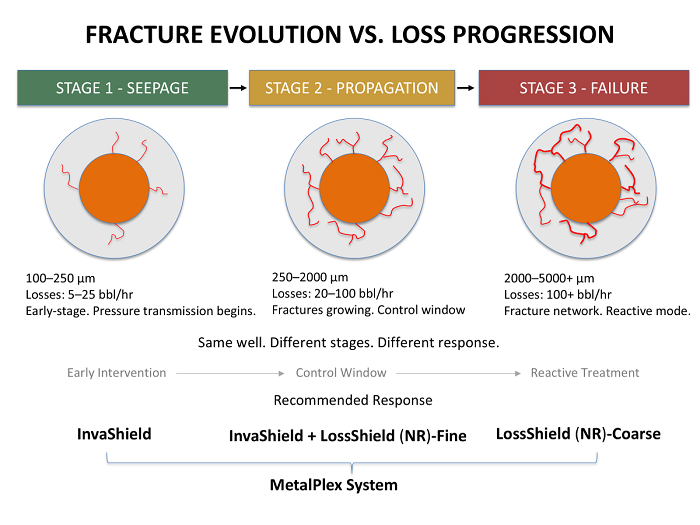
Materials are designed to provide:
- progressive response across loss severity
- compatibility across different loss mechanisms
- flexibility for standalone or combined application
Material Behaviour and System Response
InvaSeal materials are engineered to function effectively across a range of flow conditions and pressure environments encountered during drilling.
Key design considerations include:
- controlled interaction with drilling fluids
- adaptability to varying loss geometries
- stability under dynamic pressure conditions
This enables the materials to maintain effectiveness from initial seepage control through to higher severity loss conditions.
Fluid-Based Pressure Transmission Control
In addition to solid-phase materials, InvaSeal Solutions has developed fluid-based systems designed to influence pressure transmission within the wellbore and adjacent formation.
These systems function by:
- reducing effective pressure propagation into leakage pathways
- enhancing sealing efficiency at micro-fracture and pore levels
- supporting overall wellbore stability
A key advantage of this approach is its ease of field implementation, as the system is designed to be compatible with typical drilling fluid environments and demonstrates strong tolerance to ionic contaminants.
Environmental Considerations
InvaSeal Solutions maintains a strong focus on environmental responsibility.
Wherever possible, materials are designed to:
- minimize environmental impact
- align with increasingly stringent regulatory requirements
- provide effective performance without reliance on hazardous components
A significant portion of the product range can be considered environmentally responsible within the context of drilling operations.
Technical Positioning
The InvaSeal approach combines:
- field-driven material design
- integrated treatment of loss mechanisms
- fluid and solid-phase system interaction
- practical field applicability
This results in solutions that are not only technically robust but also operationally effective in real-world drilling environments.